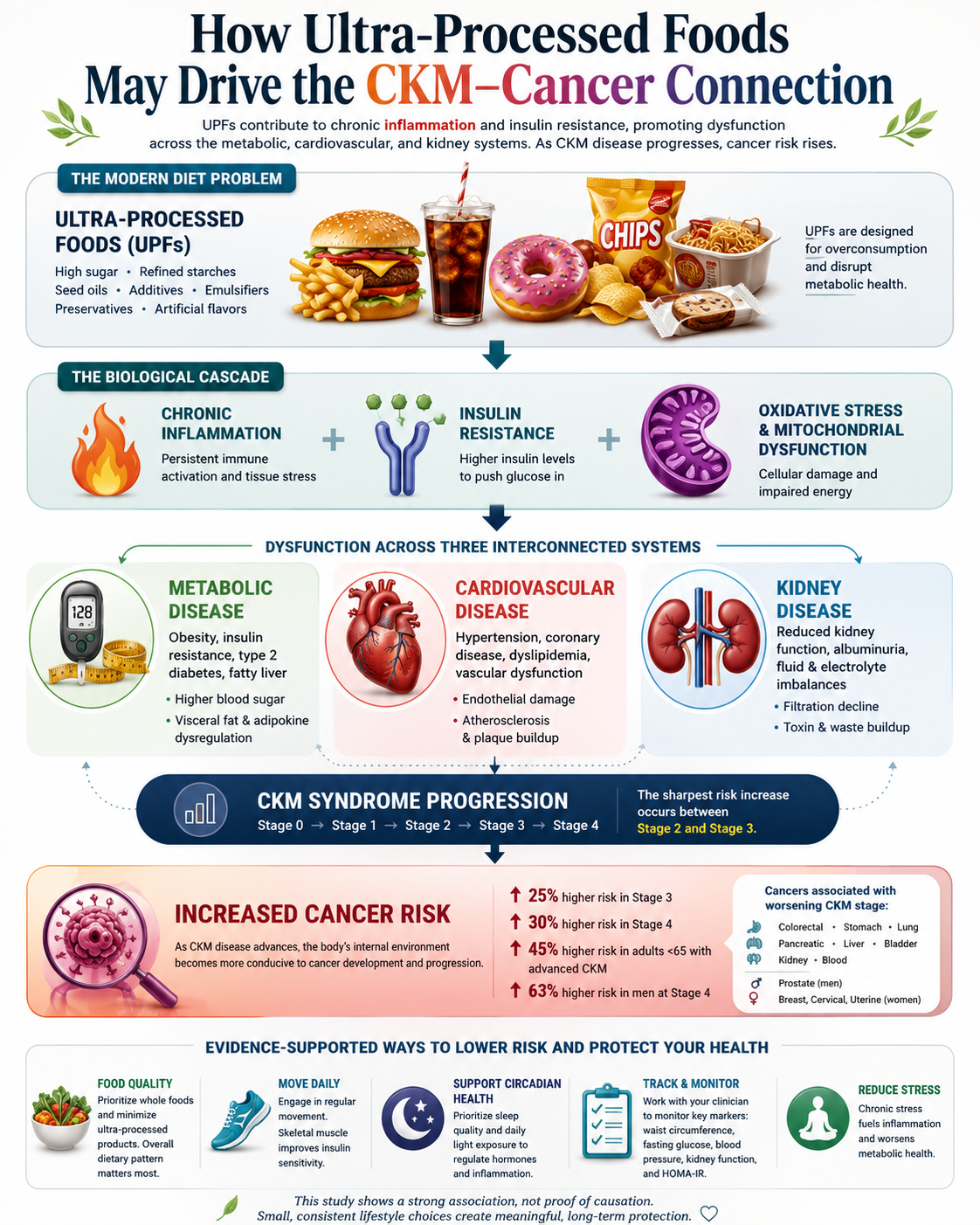
The American Heart Association's Cardiovascular-Kidney-Metabolic (CKM) syndrome staging framework describes something increasingly recognized in medicine: the heart, kidneys, and metabolism don't decline in isolation from one another — they decline together, each accelerating the others. A large study published in Circulation: Population Health and Outcomes in April 2026 followed more than 1.39 million adults in Japan and asked whether that combined decline also predicts cancer risk. The answer was yes, and the shape of that risk is worth understanding in detail.
Where the Risk Actually Jumps
Researchers staged participants from CKM stage 0 (no metabolic, kidney, or cardiovascular dysfunction) through stage 4 (advanced disease across all three systems), drawing on health records and insurance claims collected between 2014 and 2023, with a median follow-up of 3.4 years. Participants with a prior cancer diagnosis were excluded, isolating new cancer diagnoses that emerged during follow-up.
Cancer incidence rose from 81.2 cases per 10,000 person-years in the healthiest group to roughly 251 cases in stage 3 and 258 in stage 4. The sharpest single increase in risk occurred between stage 2 and stage 3, pointing to a real metabolic threshold rather than a gradual, linear climb.
Two findings are worth flagging specifically. Adults under 65 with advanced CKM disease showed a 45% higher cancer risk than their healthier peers, challenging the assumption that metabolic-driven cancer risk is primarily a concern of older age. Men in the most advanced stage showed a 63% higher cancer risk, a larger relative increase than seen in women. The pattern held even after adjusting for smoking, alcohol use, and physical activity level.
Cancers associated with worsening CKM stage included colorectal, stomach, lung, pancreatic, liver, bladder, kidney, and blood cancers, along with prostate cancer in men and breast, cervical, and uterine cancers in women.
The Proposed Biological Mechanisms
Researchers proposed several interconnected mechanisms. Chronic inflammation keeps tissue in a persistent state of stress and repair, gradually eroding normal growth regulation. Insulin resistance forces the body to produce progressively larger amounts of insulin, and chronically elevated insulin is theorized to increase oxidative stress, strain mitochondrial function, and activate growth pathways that may help abnormal cells survive. Dysfunctional adipose tissue, particularly visceral fat, compounds this by releasing inflammatory signaling molecules and disrupting hormone regulation.
It's important to be precise about what this study establishes: as an observational study, it demonstrates a strong statistical association between advanced CKM disease and cancer incidence, not direct proof of causation. That distinction is standard scientific practice and shouldn't be glossed over.
What the Evidence Actually Supports
The study itself did not test specific dietary interventions, so any recommendations should stay within what's well-supported rather than overreaching. The core, evidence-grounded response aligns with an anti-inflammatory, insulin-stabilizing approach broadly recommended for metabolic disease prevention:
- Prioritize whole foods and minimize ultra-processed products — the overall dietary pattern matters more than any single ingredient.
- Engage in regular movement. Skeletal muscle is a primary site for glucose disposal, and consistent activity measurably improves insulin sensitivity.
- Support circadian rhythm through sleep quality and daily light exposure, both linked to insulin resistance and inflammation.
- Track relevant markers with a clinician over time — waist circumference, fasting glucose, blood pressure, kidney function, and where appropriate, HOMA-IR.
One clarification worth making: some coverage of this research has emphasized a strong claim that seed oils specifically, via linoleic acid content, are a primary driver of these mechanisms, down to specific daily gram targets. That is a more contested position within nutrition science than it is sometimes presented as being, and the tipping-point finding in this study does not depend on that specific claim holding true. The better-supported takeaway is broader: reducing ultra-processed food intake generally, alongside movement and diet quality that supports insulin sensitivity, is where the strongest evidence points.
It's worth asking why the evidence on seed oils remains so contested. Part of the reason is genuine scientific complexity — most human data is observational, and separating seed oil intake from the broader category of ultra-processed foods it typically appears within is methodologically difficult. But part of the reason is also a well-documented pattern of industry-funded research shaping nutrition science historically, the sugar industry's funding of research in the 1960s to redirect blame toward dietary fat being a textbook example. That same commercial dynamic exists on both sides of the seed oil debate today. Neither observation resolves the underlying question of harm or safety — it simply means funding sources and commercial incentives warrant the same scrutiny as the nutritional claim itself.
The larger implication of this research is that cardiovascular health, kidney health, metabolic health, and cancer risk should not be evaluated as separate clinical silos. They appear to share overlapping biological pathways, which argues for integrated prevention strategies rather than single-disease-focused care.
This content is for educational purposes only and is not a substitute for professional medical advice. Please consult your doctor or care team before making any changes to your diet, supplements, or treatment plan.